
Stavros Papagiannis
Convulsive beauty
press release
Stavros Papagiannis
Convulsive beauty
Opening: 2 October 2026
Duration: 2 – 31 October 2026
Beauty will be convulsive or not at all … Convulsive beauty will be veiled-erotic, fixed-explosive, magic-circumstantial or not at all.
André Breton, Nadja (1928)
Crux Galerie presents the solo exhibition of Stavros Papagiannis, titled Convulsive beauty. The exhibition brings together a new series of works that explores the relationship between image and text, and the mechanisms through which beauty is constructed and perceived. The title of the exhibition refers to André Breton and to the Surrealist conception of beauty as an experience that finds itself constantly between attraction and repulsion.
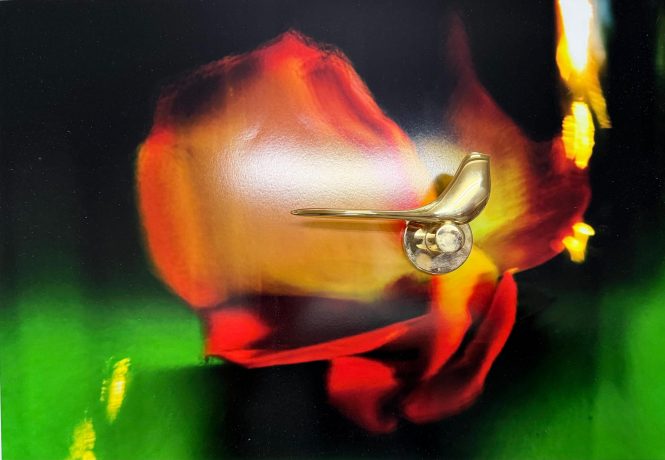
The works in the exhibition move between photography and installation. Presented is a series of diptychs consisting of a museum label describing an artwork that is not there, placed alongside a photograph, an object, or a gesture by Papagiannis. The photographs, taken with a mobile phone, emerge through a process between automatism, chance, and intention. Impressions of everyday life are detached from their original context and repositioned within new compositions or connections, next to other objects and references.
Through the reframing of the museum label, a tool of documentation and interpretation, Papagiannis borrows the memory of works by other artists in order to transform a past experience into material for new works. By placing the labels alongside his own images, he utilises the text to give them new meanings. Following art theorist and critic Rosalind Krauss and her essay “The Photographic Conditions of Surrealism” (1981), photography constitutes a primary medium of Surrealist expression, since its mechanical recording allows the image of reality to be transformed into a form of symbolic writing.
The framing, positioning and installation of the works in the exhibition also contribute to this process of coexistence. They function as structural elements of the composition, determining the connections between image, object, and text. The relationship between original and copy, authority and appropriation, art history and personal image, remains deliberately unstable. Images adopt titles that do not belong to them, museum texts are repositioned, and something familiar appears as uncanny. Ultimately, the exhibition moves freely and playfully between the personal snapshot and the institutional image, the readymade and the constructed and it invites us to embrace the spontaneity of our gaze.